
Table of Contents
The 20-volume Oxford Dictionary’s Second Edition has a whopping 171,476 words that are currently in use in the English language. Webster’s Third New International Dictionary, on the other hand, includes close to 470,000 entries for new words. These numbers, however, do not accurately cover the expanse of words and meanings that are encompassed within the English language. Your current vocabulary may include many daily use English words, but are you aware of the right antonym words to use in your conversations?
The word “antonym” has its origins in the Greek language. The Greek word for “opposite” is “anti” and “name” is “onym.” Antonyms, therefore, are words that have opposite or contrasting meanings. Understanding the kinds of antonyms and examples of the same can help you create an impact in your everyday conversations.
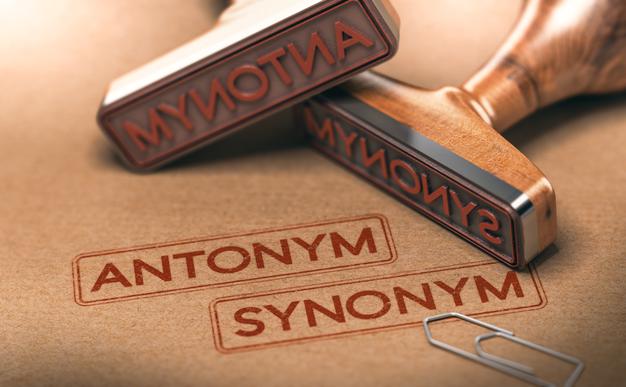
List of 100 common antonyms
Here are 100 common antonyms that can be an excellent tool to enrich your vocabulary and foster meaningful conversations in English.
- Artificial – Natural
- Arrive – Depart
- Argue – Agree
- All – None
- Amateur – Professional
- Alive – Dead
- Advanced – Elementary
- Adult – Child
- Ancestor – Descendant
- Angel – Devil
- Boy – Girl
- Build – Destroy
- Buy – Sell
- Borrow – Lend
- Body – Soul
- Blunt – Sharp
- Bitter – Sweet
- Bottom – Top
- Boring – Exciting
- Busy – Lazy
- Ceiling – Floor
- Catch – Miss
- Careful – Careless
- Calm – Excited
- Close – Open
- Cold – Hot
- Clear – Cloudy
- Child – Adult
- Certainly – Probably
- Callous – Sensitive
- Die – Live
- Dictatorship – Republic
- Dainty – Clumsy
- Desperate – Hopeful
- Divide – Unite
- Domestic – Foreign
- Distant – Near
- Different – Alike
- Drama – Comedy
- Dull – Interesting
- Emigration – Immigration
- Empty – Full
- Eager – Apathetic
- Everything – Nothing
- Evening – Morning
- Even – Odd
- Exclude – Include
- Expensive – Cheap
- Export – Import
- Exit – Entrance
- Foreground – Background
- For – Against
- Forbid – Allow
- Flippant – Somber
- Flat – Hilly
- Future – Past
- Frequently – Occasionally
- Funny – Serious
- Free- Dependent
- Friend – Enemy
- Gaiety – Misery
- Give – Take
- Guest – Host
- Guilty – Innocent
- Gentle – Violent
- Gentleman – Lady
- General – Particular
- Grown-Up – Child
- Good – Bad
- Giant – Tiny
- Heavy – Light
- Heaven – Hell
- Hopeful – Desperate
- Health – Disease
- Hate – Love
- Harvest – Plant
- Handsome – Ugly
- Happy – Sad
- High – Low
- Here – There
- Intentional – Accidental
- Intelligent – Silly
- Inside – Outside
- Ignore – Notice
- Increase – Reduce
- Interrupt – Continue
- Insult – Compliment
- Ill – Healthy
- Ignore – Notice
- Import – Export
- Loser – Winner
- Lower – Higher
- Marry – Divorce
- Mend – Break
- Midnight – Noon
- Melt – Freeze
- Negative – Affirmative
- Native – Foreigner
- Nasty – Nice
- Narrow – Broad

Types of antonyms
It is imperative for English language speakers to have an understanding of when to use what word. This can help speakers structure their conversations and convey their message accurately.
Understanding the kinds of antonyms in English is a good step towards creating meaningful and relevant sentences – both verbal and written.
1. Auto antonyms
Auto-antonyms are words that have two meanings, including an opposite meaning. Auto-antonyms are also referred to as “Janu words” and “contronym.”
Examples of auto-antonyms are-
I. Clip (Verb)
Meaning 1 – To hold tightly or fasten together.
Meaning 2 – To cut off or cut apart.
II. Give Out (Verb)
Meaning 1 – To stop producing or cease functioning.
Meaning 2 – To distribute or produce
III. Bound (Verb)
Meaning 1 – To spring or leap.
Meaning 2 – To be restrained by a material such as rope.
IV. Moot (Adjective)
Meaning 1 – Something academic and debatable.
Meaning 2 – Irrelevant.
V. Oversight (Noun)
Meaning 1 – To keep under watchful care or supervision
Meaning 2 – To omit or make an omission.
2. Complementary antonyms
Complementary antonym words are also referred to as contradictory antonyms or direct antonyms. These are words that exist independently of one another, and do not need any other term or definition to be included in a statement.
Examples of complementary antonyms are-
I. True – False
II. Entrance – Exit
III. Night – Day
IV. Dead – Alive
V. Pass – Fail
3. Relational antonyms
Relational antonyms are also referred to as converse antonyms. This term describes word pairs where the opposite makes sense only in the context of the relationship between the two meanings. An example of relational antonyms is “near” and “far,” since an object cannot be considered near without measuring it against an object that is far away.
Examples of relational antonyms include-
I. Teacher – Pupil
II. Teach – Learn
III. Come – Go
IV. Parent – Child
V. Doctor – Patient

4. Graded Antonyms
Graded antonyms show a variation or grade between words that have similar meanings. For example, the words “overjoyed,” “gratified,” “pleased,” and “content” have a connection in relation to the word happy. These antonyms can be used in place of regular-use terms.
Additional examples of graded antonyms include-
I. Healthy – Vigorous, Fit, Strong
II. Sad – Gloomy, Dejected, Miserable
III. Stupid – Obtuse, Foolish, Unwise, Dim
IV. Petite – Slight, Little
V. Big – Huge, Full-Size, Bulky
The function of antonyms
- Learning antonyms is an easy and effective way of enhancing your vocabulary.
- Recognizing words in combination with the other or in relation to other groups of words can help you derive the right meanings and insights.
- Studying antonyms allows you to choose your words appropriately when conveying a message to your audience.
- Learning these opposite words will additionally facilitate following instructions and directions to the T.
- Antonym words help you better describe the state of the world around you.
Key takeaways
- The word “antonym” is derived from the Greek equivalent of the words “opposite” and “name.” Therefore, antonym words are help convey the opposite aspect of an idea.
- There are a number of antonyms that are used in everyday conversation. Understanding these antonyms can help structure sentences and increase vocabulary.
- There are four different kinds of antonyms- auto-antonyms, complementary antonyms, relational antonyms, and graded antonyms.
- Understanding the applications of antonyms is key to using them effectively and without errors.
FAQs
Q1. What is the difference between a synonym and an antonym?
Answer – Synonyms are words that have the same or a similar meaning to a given word. Antonyms are words that have an opposite meaning.
Q2. What is a synecdoche?
Answer – A synecdoche is a figure of speech, in which a part represents a whole.
Q3. How are antonyms used in debates?
Answer – Antonyms can be used effectively in debates to draw comparisons between two or more points of view.
Feel free to check out our blog for more such lists and tips!
All the best!

People also liked
 Academics
Latest vocabulary for IELTS | 100+ words with examples!
Last Updated on February 18, 2022 323 Views Academics
Psychology books | 7 amazing books students must know about!
Last Updated on February 16, 2022 297 Views Academics
Frequently asked NEET questions you should know
Last Updated on February 16, 2022 331 Views Academics
Frequently asked GRE math questions you should know!
Last Updated on February 14, 2022 329 Views Academics
Business books | Check out these recommendations by leaders!
Last Updated on February 10, 2022 276 Views Academics




 Discover Admission Days: USA, UK, Canada & Beyond!